
Science 4th grade | UNIT 5: Electricity and magnetism 5.3 Switches
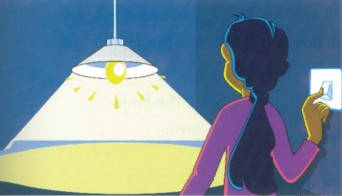
Sarena turns on the light switch. The switch closes the circuit and the light shines. When she turns off the switch, the circuit breaks and the light goes off.
A switch is another component in an electrical circuit. The switch turns the electric current on or off. It is the same idea as turning a tap on or off.
The circuit you made in Activity 5.2 had no switch. To break the circuit you took the taped wire off one of the cell terminals. A switch lets you turn a bulb on and off when you like, without having to break wires.
Activity 5.3a (Making a switch)
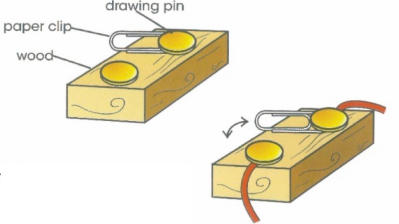
You will need: a small block of wood - two metal drawing pins - wire - a sharp knife - a metal paper clip
Put together the parts as shown. Strip the plastic off the ends of the two pieces of wire. Wind one end of each piece of wire round the drawing pins as shown.
Press the paper clip down until it touches the other drawing pin. This completes the circuit. To switch off, lift the paper clip off the drawing pin. This breaks the circuit.
Activity 5.3b (Making a circuit with a switch)
You will need: a switch - a cell - a bulb in a bulb holder - 30 cm wire - a sharp knife - scissors
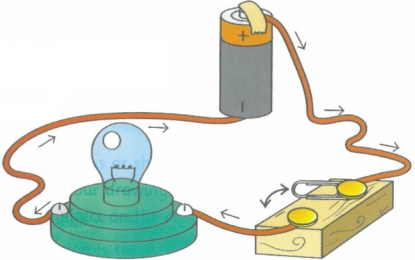
Make a circuit like the one shown.
Predict what will happen when you close the switch.
Close the switch. Observe the bulb. What happens? If the bulb does not light up, check all your connections in the circuit. Try again.
Questions
1) Why does the bulb light up when you close the switch?
2) What must you do with the switch to break the circuit?
3) Draw the circuit you made. Label the cell, the wire, the switch, the bulb and the bulb holder.
4) Why did you need to check your connections if the bulb did not light up?