
Science 4th grade | UNIT 5: Electricity and magnetism 5.5 Circuits with more buzzers
In Activity 5.4, you left just one bulb in your circuit. The bulb probably popped or burnt out. This was because the source of electricity was too strong for one bulb.
Different components need different strengths of electricity. A buzzer is another component of a circuit. It needs a stronger supply of electricity than a bulb.
The strength of electricity is measured in a unit called a volt (V). The strength of electricity that a component needs for it to work is called the voltage.
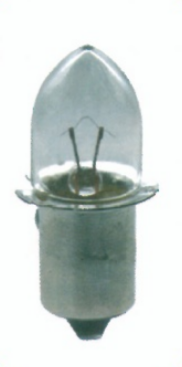
|
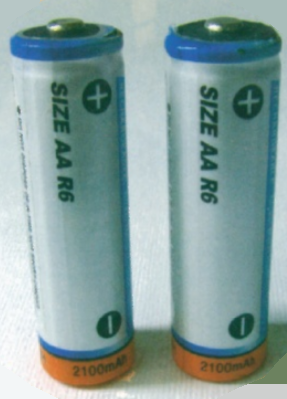
|
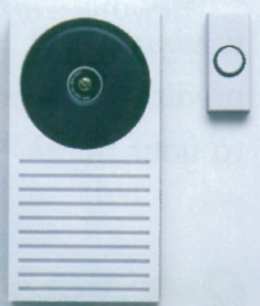
|
Activity 5.5 (Making a circuit with a buzzer)
You will need: three 1.5V cells - a 3 V buzzer a switch - wire - a knife scissors - tape . elastic band a stick
If you put a 3 V buzzer into a circuit, you need a 3 V cell to make the buzzer work. You can make a 3 V supply by joining two 1.5V cells.
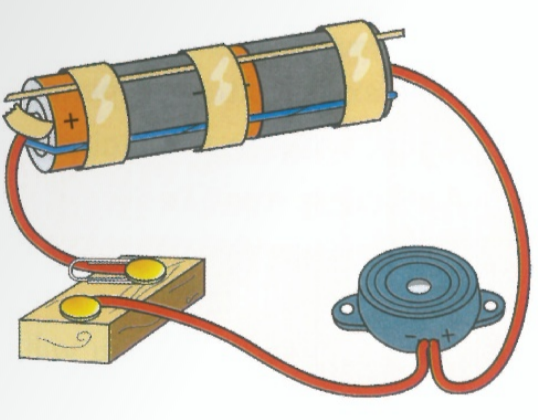
Check on the side of the buzzer to see which side is positive (+) and which side is negative (-). Connect the buzzer in the circuit so that the (+) terminal is connected to the (-) terminal of the cell. Set up your circuit like the one shown in the picture.
Test your circuit. Does the buzzer make a noise when you close the switch? Take away one of the cells. Test your circuit again. Add two cells. Now your circuit has three cells. Test your circuit again.
Questions
1) How well did the buzzer work when you had three cells in the circuit?
2) How well did the buzzer work when you had one cell in the circuit?
3) Why do you need at least 3 V to make the buzzer work in your circuit?
4) You want to run an electric toy that has a voltage of 6 V. Why won't it work properly when you use a 1.5V cell?