Science 8th grade | UNIT 3: The circulatory system 3.2 The human circulatory system
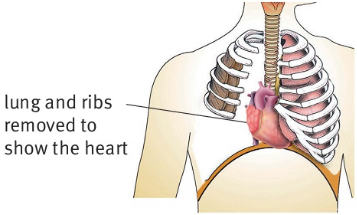
The diagram shows where your heart is. It is just under your ribs, slightly to left of centre of your body.
Your heart is about the same size as your clenched fist. It is made of very strong muscle. The muscle in the heart contracts and relaxes over and over again, all through your life. However tired you are, your heart still keeps beating.
The structure of the heart
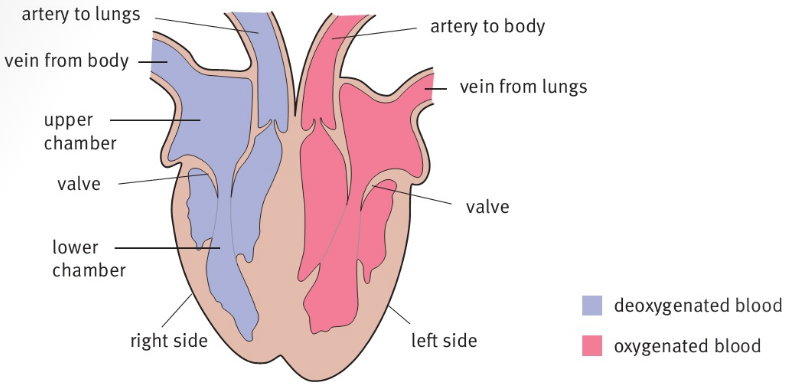
The diagram shows what the inside of the heart looks like.
Question
$A + I$: 1) The heart has four chambers - an upper and lower chamber on the left, and an upper and lower chamber on the right.
a: Into which chamber does blood from the lungs flow?
b: Out of which chamber does blood flow, on its way to the rest of the body?
c: Which two chambers contain oxygenated blood?
How the heart works
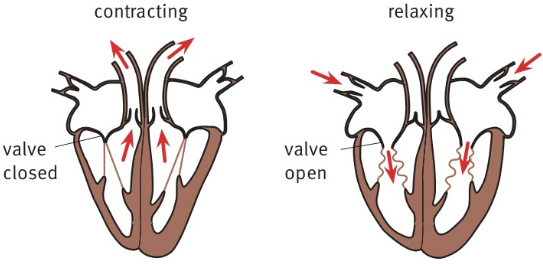
The heart is made of muscle. This muscle contracts and then relaxes. When muscle contracts, it gets shorter. This makes the walls of the heart chambers squeeze inwards. This pushes blood out of the heart.
There are valves between the upper chambers and the lower chambers. The valves only let the blood flow from the upper chamber to the lower chamber. There are also valves in the big arteries coming out of the heart. These valves only let the blood flow out, not back into the heart.
This is what happens during one heart beat:
• The heart muscle contracts, pushing blood out into the arteries.
• The heart muscle relaxes, allowing blood to flow into the heart from the veins.
Activity 3.2 (Investigating the effect of exercise on pulse rate)
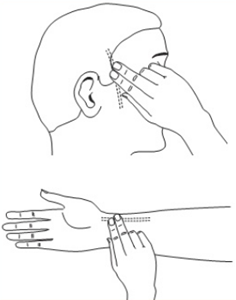
Each time your heart muscle contracts, it sends blood surging through your arteries. You can feel this surge of blood if you put your fingers on a place where there is an artery near the surface of the body. The diagrams show two good places to try.
Each surge of blood is called a pulse. Your pulse rate is the number of pulses in one minute.
1) Read through what you are going to do Draw a results table, ready to write in your results as you collect them.
2) Work with a partner. Ask them to sit very still and relaxed for a few minutes. Then count their pulse rate.
3) Now ask your partner to do some exercise for two minutes.
Your teacher will suggest a good exercise to do.
4) As soon as your partner has finished exercising, count their pulse rate again.
5) Continue to count their pulse rate every two minutes for ten minutes.
6) Draw a graph to display your results.
7) Use your results to write a short conclusion.