chevron_backward

Mathematics 7th grade | UNIT 2: Sequences‚ expressions and formulae 2.3 Representing simple functions

chevron_forward
visibility 186update 3 years agobookmarkshare

A function is a relationship between two sets of numbers.
A function can be shown as a function machine like this.
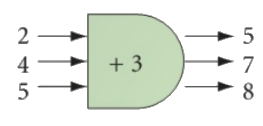
The numbers that you put into the function machine are called the input.
The numbers that you get out of the function machine are called the output.
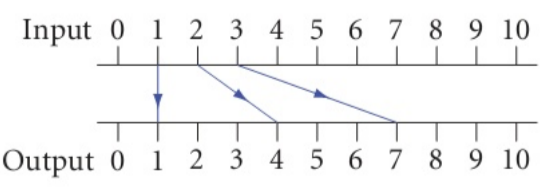
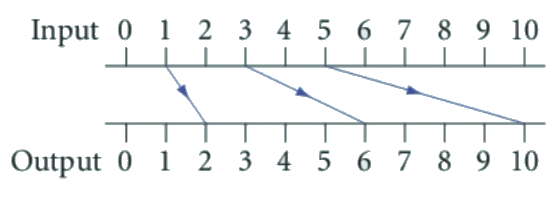
A function can also be shown as a mapping diagram like this.
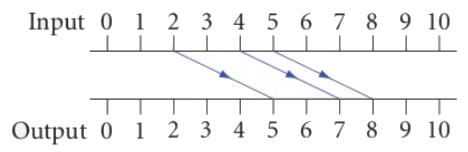
Input  Output

Worked example 2.3

a: Find the missing inputs and outputs in this function machine.
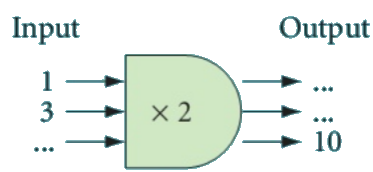
Input                      Output 1                                ... 3           x2                 ... ...                               10

b: Draw a mapping diagram to show the function in part a.

a:  a Input                        Output 1                                   2 3           x2                    6 5                                  10
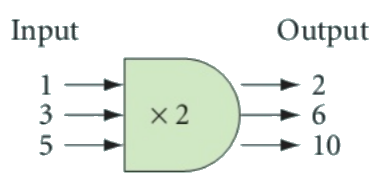
To work out the outputs, multiply the inputs by 2.
$1 \times 2 = 2\,\,,\,\,3 \times 2 = 6$
To work out the input, work backwards and divide the output by 2.
$10 \div 2 = 5$
b: Input Output
Exercise 2.3

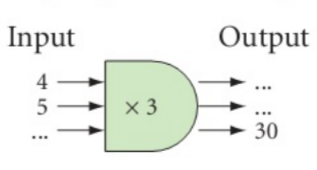
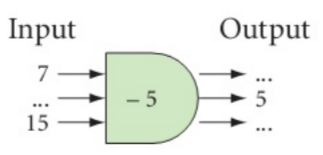
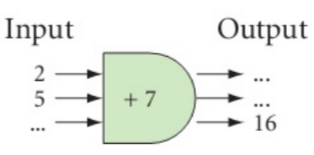
1) Copy these function machines and work out the missing inputs and outputs.
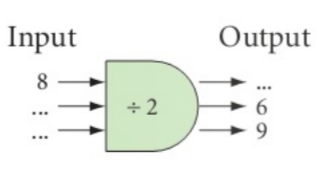
Input            Output
d
Input            Output
c
Input            Output
b
Input            Output
a

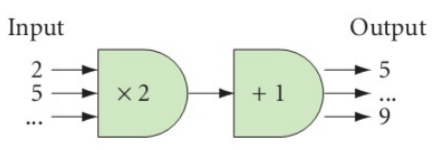
2) Copy these function machines and work out the missing inputs and outputs.
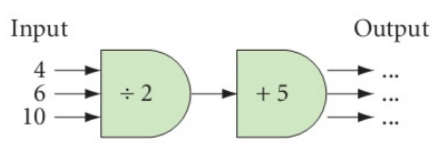
Input               Output $\begin{array}{*{20}{c}}   {4 \to } \\    {6 \to } \\    {10 \to }  \end{array} \div 2 \to  + 5\begin{array}{*{20}{c}}   { \to ...} \\    { \to ...} \\    { \to ...}  \end{array}$
b
Input            Output $\begin{array}{*{20}{c}}   {2 \to } \\    {5 \to } \\    {... \to }  \end{array}\,\,\,\,\, \times 2 \to \, + 1\,\begin{array}{*{20}{c}}   { \to 5} \\    { \to ...} \\    { \to 9}  \end{array}$
a
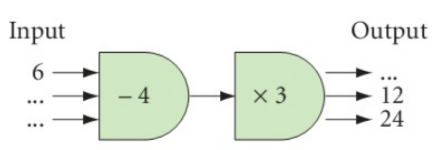
Input              Output $\begin{array}{*{20}{c}}   {6 \to } \\    {... \to } \\    {... \to }  \end{array} - 4 \to  \times 3\begin{array}{*{20}{c}}   { \to ...} \\    { \to 12} \\    { \to 24}  \end{array}$
d
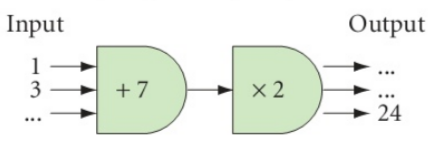
Input           Output $\begin{array}{*{20}{c}}   {1 \to } \\    {3 \to } \\    {... \to }  \end{array} + 7 \to  \times 2\begin{array}{*{20}{c}}   { \to ...} \\    { \to ...} \\    { \to 24}  \end{array}$
c

3) a: Work out the rule to complete cach of these function machines.
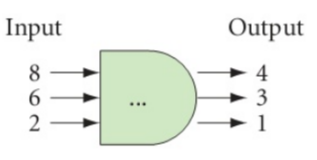
Input                    Output  $\begin{array}{*{20}{c}}   {8 \to } \\    {6 \to } \\    {2 \to }  \end{array}...\begin{array}{*{20}{c}}   { \to 4} \\    { \to 3} \\    { \to 1}  \end{array}$
ii
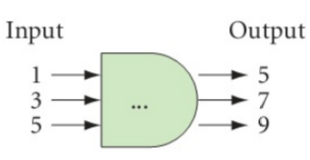
Input          Output $\begin{array}{*{20}{c}}   {1 \to } \\    {3 \to } \\    {5 \to }  \end{array}...\begin{array}{*{20}{c}}   { \to 5} \\    { \to 7} \\    { \to 9}  \end{array}$
i

b: Make two copies of the diagram below.
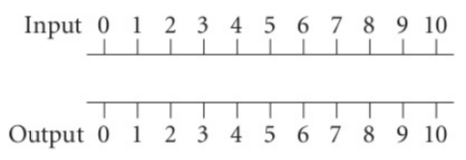
Input Output

Draw a mapping diagram for each of the functions in part a.

4) Tanesha and Dakarai look at this function machine.
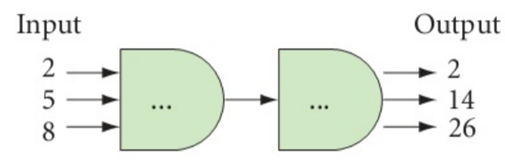
Input                       Output $\begin{array}{*{20}{c}}   {2 \to } \\    {5 \to } \\    {8 \to }  \end{array}... \to ...\begin{array}{*{20}{c}}   { \to 2} \\    { \to 14} \\    { \to 26}  \end{array}$

Is either of them correct? Explain your answer.

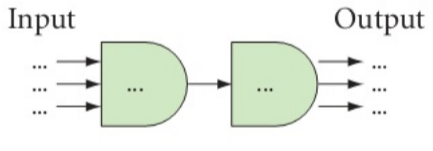
5) Chin-Mac draws this mapping diagram and function machine for the same function.

Input Output

Input Output

Fill in the missing numbers and the rule in the function machine.

Related Past Papers

Related Tutorials

warning Crash report
home
grid_view
add
explore
account_circle