Physics A Level | Chapter 1: Kinematics 1.5 Combining displacements
chevron_forward
visibility 583update 4 years agobookmarkshare
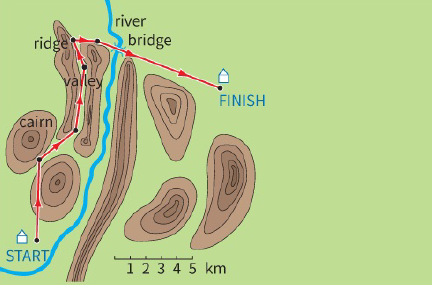
The walkers shown in Figure 1.12 are crossing difficult ground. They navigate from one prominent point to the next, travelling in a series of straight lines. From the map, they can work out the distance that they travel and their displacement from their starting point:
distance travelled = $25 km$
.Figure 1.12: In rough terrain, walkers head straight for a prominent landmark
(Lay thread along route on map; measure thread against map scale.)
displacement = $15 km$ in the direction ${045^ \circ },N{45^ \circ }$ E or north-east
(Join starting and finishing points with straight line; measure line against scale.)
A map is a scale drawing. You can find your displacement by measuring the map. But how can you calculate your displacement? You need to use ideas from geometry and trigonometry. Worked examples 3 and 4 show how.
WORKED EXAMPLES
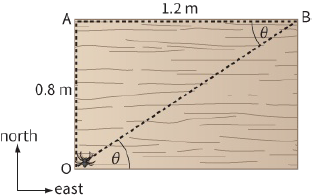
3) A spider runs along two sides of a table (Figure 1.13). Calculate its final displacement.
Figure 1.13: The spider runs a distance of $2.0 m$. For Worked example 3.
Step 1: Because the two sections of the spider’s run (OA and AB) are at right angles, we can add the two displacements using Pythagoras’s theorem:
$\begin{array}{l}
O{B^2} = O{A^2} + A{B^2}\\
= 0.{8^2} + 1.{2^2} = 2.08\\
OB = \sqrt {2.08} = 1.44m \approx 1.4m
\end{array}$ Step 2: Displacement is a vector. We have found the magnitude of this vector, but now we have to find its direction. The angle $\theta $ is given by:
$\begin{array}{l}
\tan \theta = \frac{{opp}}{{adj}} = \frac{{0.8}}{{1.2}}\\
= 0.667
\end{array}$
$\begin{array}{l}
\theta = {\tan ^{ - 1}}(0.667)\\
= 33.{7^ \circ } \approx {34^ \circ }
\end{array}$
So the spider’s displacement is $1.4 m$ at ${056^ \circ }$ or $N{056^ \circ }E$ or at an angle of ${34^ \circ }$ north of east.
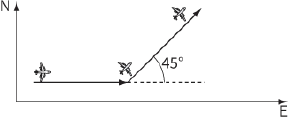
4) An aircraft flies $30 km$ due east and then $50 km$ north-east (Figure 1.14). Calculate the final displacement of the aircraft.
Figure 1.14: For Worked example 4.
Here, the two displacements are not at ${90^ \circ }$ to one another, so we can’t use Pythagoras’s theorem.
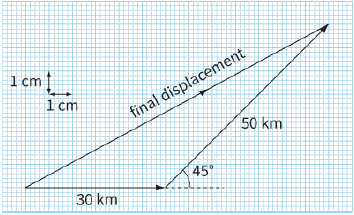
We can solve this problem by making a scale drawing, and measuring the final displacement.
(However, you could solve the same problem using trigonometry.) Step 1: Choose a suitable scale. Your diagram should be reasonably large; in this case, a scale of $1cm$ to represent $5 km$ is reasonable. Step 2: Draw a line to represent the first vector. North is at the top of the page. The line is $6 cm$ long, towards the east (right). Step 3: Draw a line to represent the second vector, starting at the end of the first vector. The line is $10 cm$ long, and at an angle of ${45^ \circ }$ (Figure 1.15)
Figure 1.15: Scale drawing for Worked example 4. Using graph paper can help you to show the vectors in the correct directions.
Step 4: To find the final displacement, join the start to the finish. You have created a vector triangle. Measure this displacement vector, and use the scale to convert back to kilometres:
length of vector = $14.8 cm$
final displacement = $14.8 \times 5 = 74\,km$ Step 5: Measure the angle of the final displacement vector:
angle = ${28^ \circ }\,N$ of E
Therefore the aircraft’s final displacement is $74 km$ at ${28^ \circ }\,$ north of east, ${062^ \circ }\,$ or $N{62^ \circ }\,E$.
Questions
14) You walk $3.0 km$ due north, and then $4.0 km$ due east.
a: Calculate the total distance in km you have travelled.
b: Make a scale drawing of your walk, and use it to find your final displacement. Remember to give both the magnitude and the direction.
c: Check your answer to part b by calculating your displacement.
15) A student walks $8.0 km$ south-east and then $12 km$ due west.
a: Draw a vector diagram showing the route. Use your diagram to find the total displacement.
Remember to give the scale on your diagram and to give the direction as well as the magnitude of your answer.
b: Calculate the resultant displacement. Show your working clearly.
This process of adding two displacements together (or two or more of any type of vector) is known as vector addition. When two or more vectors are added together, their combined effect is known as the resultant of the vectors.