
Physics A Level | Chapter 1: Kinematics 1.6 Combining velocities
Velocity is a vector quantity and so two velocities can be combined by vector addition in the same way that we have seen for two or more displacements.
Imagine that you are attempting to swim across a river. You want to swim directly across to the opposite bank, but the current moves you sideways at the same time as you are swimming forwards. The outcome is that you will end up on the opposite bank, but downstream of your intended landing point. In effect,
you have two velocities:
- the velocity due to your swimming, which is directed straight across the river
- the velocity due to the current, which is directed downstream, at right angles to your swimming velocity.
These combine to give a resultant (or net) velocity, which will be diagonally downstream. In order to swim directly across the river, you would have to aim upstream. Then your resultant velocity could be directly across the river.
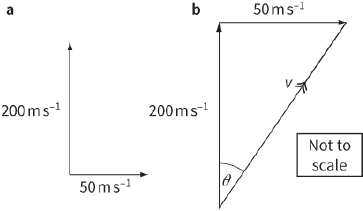
Questions
16) A swimmer can swim at $2.0\,m\,{s^{ - 1}}$ in still water. She aims to swim directly across a river that is flowing at $0.08\,m\,{s^{ - 1}}$. Calculate her resultant velocity. (You must give both the magnitude and the direction.)
17) A stone is thrown from a cliff and strikes the surface of the sea with a vertical velocity of $18\,m\,{s^{ - 1}}$ and a horizontal velocity v. The resultant of these two velocities is $25\,m\,{s^{ - 1}}$.
a: Draw a vector diagram showing the two velocities and the resultant.
b: Use your diagram to find the value of v.
c: Use your diagram to find the angle between the stone and the vertical as it strikes the water.