Physics A Level | Chapter 2: Accelerated motion 2.1 The meaning of acceleration
chevron_forward
visibility 577update 4 years agobookmarkshare
LEARNING INTENTIONS
In this chapter you will learn how to:
- define acceleration
- draw and interpret graphs of speed, velocity and acceleration
- calculate displacement from the area under a velocity–time graph
- calculate velocity and acceleration using gradients of a displacement–time graph and a velocity–time graph
- derive and use the equations of uniformly accelerated motion
- describe an experiment to measure the acceleration of free fall, g
- use perpendicular components to represent a vector
- explain projectile motion in terms of uniform velocity and uniform acceleration.
BEFORE YOU START
Write down definitions of speed and velocity.
Write a list of all the vectors that you know. Why are some quantities classed as vectors?
QUICK OFF THE MARK
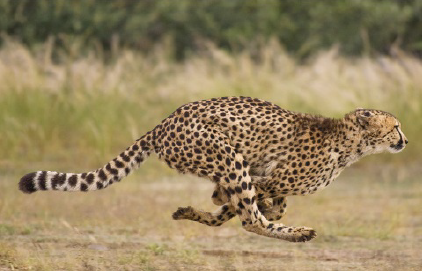
The cheetah (Figure 2.1) has a maximum speed of more than $30\,m\,\,{s^{ - 1}}$ ($108 km/h$). A cheetah can reach $20\,m\,\,{s^{ - 1}}$ from a standing start in just three or four strides, taking only two seconds.
A car cannot increase its speed as rapidly but on a long straight road it can easily travel faster than a cheetah.
How do you think such measurements can be made? What apparatus is needed?
Figure 2.1: The cheetah is the world’s fastest land animal. Its acceleration is impressive, too.
In everyday language, the term accelerating means ‘speeding up’. Anything whose speed is increasing is accelerating. Anything whose speed is decreasing is decelerating.
To be more precise in our definition of acceleration, we should think of it as changing velocity. Any object whose speed is changing or which is changing its direction has acceleration. Because acceleration is linked to velocity in this way, it follows that it is a vector quantity.
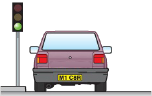
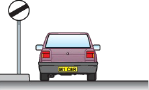
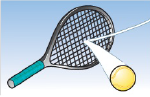
Some examples of objects accelerating are shown in Figure 2.2.
Figure 2.2: Examples of objects accelerating.
A car settting off from the traffic lights. There is an instant when the car is both stationary and accelerating. Otherwise it would not start moving
A car speeding up as it leaves the town. The driver presses on the accelertor pedal to increase the car's velocity
A ball being hit by a tennis racket. Both the ball's speed and direction are changing. The ball's velocity changes
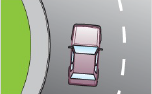
A car travelling round a bend at a steady speed. The car's speed is constant, but its velocity is changing as it changes direction
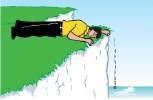
A stone dropped over a cliff. Gravity makes the stone go faster and faster. The stone accelerates as it falls