
Physics A Level | Chapter 2: Accelerated motion 2.2 Calculating acceleration
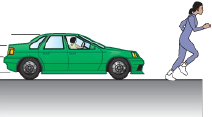
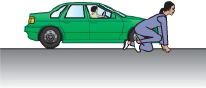
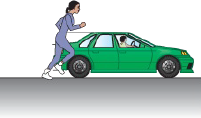
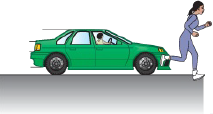
The acceleration of something indicates the rate at which its velocity is changing. Language can get awkward here. Looking at the sprinter in Figure 2.3, we might say, ‘The sprinter accelerates faster than the car.’ However, ‘faster’ really means ‘greater speed’. It is better to say, ‘The sprinter has a greater acceleration than the car.’
Acceleration is defined as follows:
$acceleration = rate\,of\,velocity$
$average\,acceleration = \frac{{change\,in\,velocity}}{{time\,taken}}$
So to calculate acceleration a, we need to know two quantities – the change in velocity $\Delta v$ and the time taken $\Delta t$:
$a = \frac{{v - u}}{t}$
Sometimes this equation is written different
ly. We write u for the initial velocity and v for the final velocity (because u comes before v in the alphabet). The moving object accelerates from u to v in a time t (this is the same as the time represented by $\Delta t$ in the equation). Then the acceleration is given by the equation:
|
|
|
|
You must learn the definition of acceleration. It can be put in words or symbols. If you use symbols you must state what those symbols mean.