
Physics A Level | Chapter 2: Accelerated motion 2.11 Acceleration caused by gravity
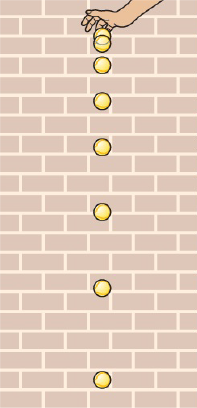
If you drop a ball or stone, it falls to the ground. Figure 2.21, based on a multiflash photograph, shows the ball at equal intervals of time. You can see that the ball’s velocity increases as it falls because the spaces between the images of the ball increase steadily. The ball is accelerating.
A multiflash photograph is useful to demonstrate that the ball accelerates as it falls. Usually, objects fall too quickly for our eyes to be able to observe them speeding up. It is easy to imagine that the ball moves quickly as soon as you let it go, and falls at a steady speed to the ground. Figure 2.21 shows that this is
not the case.
If we measure the acceleration of a freely falling object on the surface of the Earth, we find a value of about $9.81\,m\,{s^{ - 2}}$. This is known as the acceleration of free fall, and is given the symbol g:
acceleration of free fall $g = 9.81\,m\,{s^{ - 2}}$
The value of g depends on where you are on the Earth’s surface, but we usually take $g = 9.81\,m\,{s^{ - 2}}$.
If we drop an object, its initial velocity $u = 0$. How far will it fall in time t? Substituting in gives displacement s:
$\begin{array}{l}
s = \frac{1}{2} \times 9.81 \times {t^2}\\
= 4.9 \times {t^2}
\end{array}$
Hence, by timing a falling object, we can determine g.
Questions
16) If you drop a stone from the edge of a cliff, its initial velocity $u = 0$, and it falls with acceleration $g = 9.81\,m\,{s^{ - 2}}$. You can calculate the distance s it falls in a given time t using an equation of motion.
a: Copy and complete Table 2.3, which shows how s depends on t.
b: Draw a graph of s against t.
c: Use your graph to find the distance fallen by the stone in $2.5 s$.
d: Use your graph to find how long it will take the stone to fall to the bottom of a cliff $40 m$ high.
Check your answer using the equations of motion.
| 4.0 | 3.0 | 2.0 | 1.0 | 0 | Time / s |
| 4.9 | 0 | Displacement / m |
17) An egg falls off a table. The floor is $0.8 m$ from the table-top.
Calculate the time taken to reach the ground.
Calculate the velocity of impact with the ground.