
Physics A Level | Chapter 9: Kirchhoff’s laws 9.2 Kirchhoff’s second law
This law deals with e.m.f.s and voltages in a circuit. We will start by considering a simple circuit that contains a cell and two resistors of resistances ${R_1}$ and ${R_2}$ (Figure 9.8). Since this is a simple series circuit, the current I must be the same all the way around, and we need not concern ourselves further with Kirchhoff’s first law. For this circuit, we can write the following equation:
$E = I{R_1} + I{R_2}$
e.m.f. of battery = sum of p.d.s across the resistors
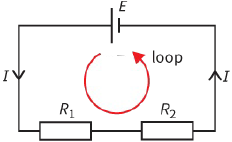
You should not find these equations surprising. However, you may not realise that they are a consequence of applying Kirchhoff’s second law to the circuit. This law states that the sum of the e.m.f.s around any loop in a circuit is equal to the sum of the p.d.s around the loop.
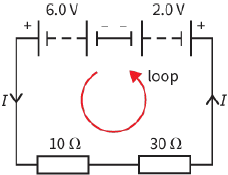
Question
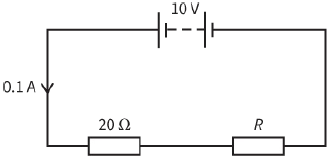
5) Use Kirchhoff’s second law to deduce the p.d. across the resistor of resistance R in the circuit shown in Figure 9.10, and hence find the value of R. (Assume the battery of e.m.f. $10 V$ has negligible internal resistance.)
An equation for Kirchhoff’s second law
In a similar manner to the formal statement of the first law, the second law can be written as an equation:
$\Sigma E = \Sigma V$
where $\Sigma E$ is the sum of the e.m.f.s and $\Sigma V$ is the sum of the potential differences.