
Physics A Level | Chapter 15: Atomic structure 15.7 Radiation from radioactive substances
The three types of radiation commonly emitted by radioactive substances – alpha ($\alpha $), beta ($\beta $) and gamma ($\gamma $)–come from the unstable nuclei of atoms. Nuclei consist of protons and neutrons, and if the balance between these two types of particles is too far to one side, or the nucleus is just too big to hold together, the nucleus may emit $\alpha - $ or $\beta - $radiation as a way of achieving greater stability. Gamma-radiation is usually emitted after $\alpha $ or $\beta $ decay, to release excess energy from the nuclei.
Table 15.4 shows the basic characteristics of the different types of radiation. The masses are given relative to the mass of a proton; charge is measured in units of e, the elementary charge. Figure 15.10 summarises the penetrating powers of the different types of radiation.
| Radiation | Symbol | Mass (relative to proton) | Charge | Typical speed |
| $\alpha - $particle | $\alpha ,\begin{array}{*{20}{c}} 4\\ 2 \end{array}He$ |
4 | $+2e$ | ‘slow’ (${10^6}\,m\,{s^{ - 1}}$) |
| ${\beta ^ - } - $particle | $\beta ,{\beta ^ - },e,\begin{array}{*{20}{c}} 0\\ { - 1} \end{array}e$ |
$\frac{1}{{1840}}$ | $−e$ | ‘fast’ (${10^8}\,m\,{s^{ - 1}}$) |
| ${\beta ^ + } - $particle | $\beta ,{\beta ^ + },{e^ + },\begin{array}{*{20}{c}} 0\\ { + 1} \end{array}e$ |
$\frac{1}{{1840}}$ | $+e$ | ‘fast’ (${10^8}\,m\,{s^{ - 1}}$) |
| $\gamma - $ray | $\gamma $ | 0 | 0 | speed of light ($3 \times {10^8}\,m\,{s^{ - 1}}$) |
Note the following points:
- $\alpha - $ and $\beta - $radiation are particles of matter. A $\gamma - $ray is a photon of electromagnetic radiation, similar to an X-ray. (X-rays are produced when electrons are decelerated; $\gamma - $rays are produced in nuclear reactions.)
An $\alpha - $particle consists of two protons and two neutrons; it is a nucleus of helium-4. A ${\beta ^ - } - $particle is simply an electron and a ${\beta ^ + } - $particle is a positron.
The mass of an $\alpha - $particle is nearly 10000 times that of an electron and it travels at roughly onehundredth of the speed of a $\beta - $particle.
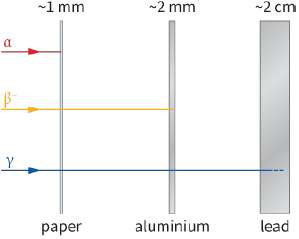
thickness of the absorbing material is also shown
Identification and properties of α-radiation
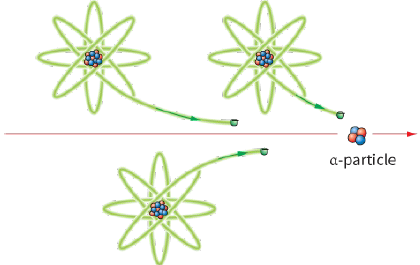
$\alpha - $particles are relatively slow moving and large particles. They were identified as helium nuclei (${H^{2 + }}$ ions) by their deflection in electric and magnetic fields (see Chapter 25). The helium nucleus, which consists of two protons and two neutrons, is extremely stable. Scientists believe that, within larger nuclei, $\alpha $ groups are continually forming, breaking apart and reforming. Occasionally, such a group will have enough energy to break away from the strong nuclear forces holding the mother nucleus together and will escape as an $\alpha - $particle. The $\alpha - $particles (which are relatively large and carry a charge) interact with atoms in the medium through which they are travelling, causing ionisation within the medium. They lose energy rapidly. This means they are not very penetrative (they are absorbed by a thin sheet of paper) and have a very short range (only a few centimetres in air).
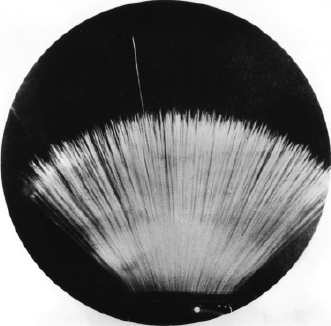
?particles all travel approximately the same distance. What does this suggest
Identification and properties of $\beta - $radiation
$\beta - $particles were identified as very fast electrons. Like $\alpha - $particles, $\beta - $particles carry a charge. But, because $\beta - $particles are much smaller, they cause less ionisation and penetrate further into matter. They are absorbed by approximately one centimetre of aluminium or one millimeter of lead.
$\beta - $decay occurs when there is an imbalance of protons and neutrons in the nucleus, usually too many neutrons. A neutron will then decay into a proton (positive) and an electron (negative). The proton remains in the new nucleus and the electron is expelled at a very high velocity. However, some isotopes (such as V-48) have excess protons; because of this, a proton decays into a neutron and emits a positively charged electron or positron. This is known as ${\beta ^ + }$ (beta plus) decay. The decay of a neutron into a proton and an electron is known as ${\beta ^ - }$ (beta minus) decay.
The positron was the first example of antimatter to be identified. It is now known that all particles have an antiparticle, which has the same mass as the particle but the opposite charge. The general term for antiparticles is antimatter.
What happens when matter meets antimatter?
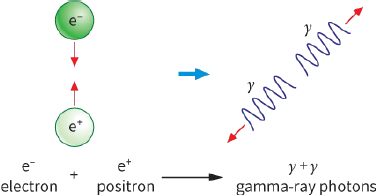
When an antiparticle meets its particle, such as a positron meets an electron, they annihilate each other and two gamma ray photons are produced and the two masses become pure energy!
What happens when matter meets antimatter?
When an antiparticle meets its particle, such as a positron meets an electron, they annihilate each other and two gamma ray photons are produced and the two masses become pure energy!
Identification and properties of $\gamma - $radiation
$\gamma - $radiation was identified from its speed in a vacuum, $3 \times {10^8}\,m\,{s^{ - 1}}$, the speed of all electromagnetic radiation. It is very high frequency electromagnetic radiation; as such, it has no rest mass and no charge.
Consequently, it does not interact with matter to the same degree as alpha or beta radiation. It produces only a small amount of ionisation and is highly penetrative – it will penetrate through several centimetres of lead.
It is generally emitted following alpha or beta decay. After the initial decay, the nucleus is left in an unstable high energy state – it will drop into a lower energy, more stable state with the emission of a gamma ray.
Question
10) a: Explain why you would expect ${\beta ^ - } - $particles to travel further through air than $\alpha - $particles.
b: Explain why you would expect ${\beta ^ - } - $particles to travel further through air than through metal.