
Physics A Level | Chapter 15: Atomic structure 15.10 Fundamental particles
Chemistry is complicated because there are billions of different molecules that can exist. The discovery of the Periodic Table simplified things because it suggested that there were roughly 92 different elements whose atoms could be arranged to make the billions of molecules. The idea that atoms are made up of just three types of particle (protons, neutrons and electrons) seemed to simplify things still more, and scientists were happy because it provided a simple explanation of a complex world.
Protons, neutrons and electrons were thought of as fundamental particles, which could not be subdivided further. However, in the middle decades of the $20th$ century, physicists discovered many other particles that did not fit this pattern. They gave them names such as pions, kaons, muons and so on, using up most of the letters of the Greek alphabet.
These new particles were found in two ways:
- by looking at cosmic rays, which are particles that arrive at the Earth from outer space
- by looking at the particles produced by high-energy collisions in particle accelerators (Figure 15.15).
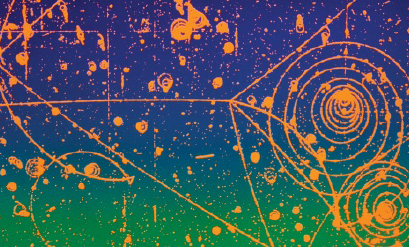
then struck another particle just to the right of the centre. Four new particles fly out from the point of
impact
The discovery of dozens of new particles with masses different from those of protons, neutrons and electrons suggested that these were not fundamental particles. Various attempts were made to tidy up this very confusing picture.