Physics A Level | Chapter 21: Uniform electric fieldsا 21.1 Attraction and repulsion

Static electricity can be useful – it is important in the process of photocopying, in dust precipitation to clean up industrial emissions and in crop-spraying, among many other applications. It can also be a nuisance. Who hasn’t experienced a shock, perhaps when getting out of a car or when touching a door handle? Static electric charge has built up and gives us a shock when it discharges.
We explain these effects in terms of electric charge. Simple observations in the laboratory give us the following picture:
- Objects are usually electrically neutral (uncharged), but they may become electrically charged, for example, when one material is rubbed against another.
- There are two types of charge, which we call positive and negative.
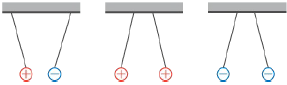
- Opposite types of charge attract one another; like charges repel (Figure 21.2).
- A charged object may also be able to attract an uncharged one; this is a result of electrostatic induction.
These observations are macroscopic. They are descriptions of phenomena that we can observe in the laboratory, without having to consider what is happening on the microscopic scale, at the level of particles such as atoms and electrons. However, we can give a more subtle explanation if we consider the microscopic picture of static electricity.
Using a simple model, we can consider matter to be made up of three types of particles: electrons (which have negative charge), protons (positive) and neutrons (neutral). An uncharged object has equal numbers of protons and electrons, whose charges therefore cancel out.
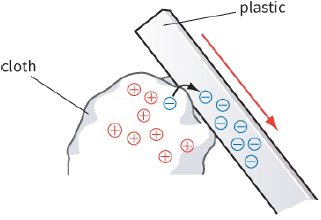
When one material is rubbed against another, there is friction between them, and electrons may be rubbed off one material onto the other (Figure 21.3). The material that has gained electrons is now negatively charged, and the other material is positively charged.
If a positively charged object is brought close to an uncharged one, the electrons in the second object may be attracted. We observe this as a force of attraction between the two objects. (This is known as electrostatic induction.)
It is important to appreciate that it is usually electrons that are involved in moving within a material, or from one material to another. This is because electrons, which are on the outside of atoms, are less strongly held within a material than are protons. They may be free to move about within a material (like the conduction electrons in a metal), or they may be relatively weakly bound within atoms.
PRACTICAL ACTIVITY 21.1
Investigating electric fields
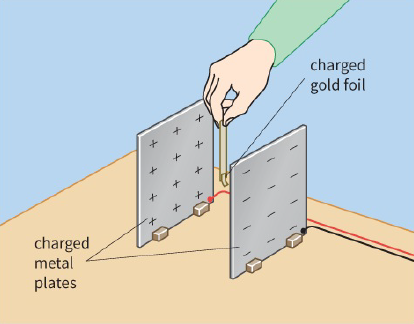
If you rub a strip of plastic so that it becomes charged and then hold it close to your hair, you feel your hair being pulled upwards. The influence of the charged plastic spreads into the space around it; we say that there is an electric field around the charge. To produce an electric field, we need unbalanced charges (as with the charged plastic). To observe the field, we need to put something in it that will respond to the field (as your hair responds). There are two simple ways in which you can do this in the laboratory. The first uses a charged strip of gold foil, attached to an insulating handle (Figure 21.4).
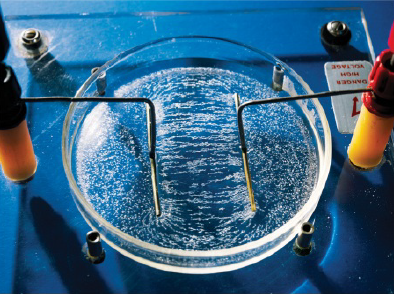
The second uses grains of a material such as semolina; these line up in an electric field (Figure 21.5),
rather like the way in which iron filings line up in a magnetic field (Figure 21.5).