Physics A Level | Chapter 22: Coulomb’s law 22.2 Coulomb’s law
Any electrically charged object produces an electric field in the space around it. It could be something as small as an electron or a proton, or as large as a planet or star. To say that it produces an electric field means that it will exert a force on any other charged object that is in the field. How can we determine the size of such a force?
The answer to this was first discovered by Charles Coulomb, a French physicist. He realised that it was important to think in terms of point charges; that is, electrical charges that are infinitesimally small so that we need not worry about their shapes. In 1785, Coulomb proposed a law that describes the force that one charged particle exerts on another. This law is remarkably similar in form to Newton’s law of gravitation.
Coulomb’s law states that any two point charges exert an electrical force on each other that is proportional to the product of their charges and inversely proportional to the square of the distance between them.
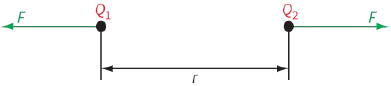
We consider two point charges ${Q_1}$ and ${Q_2}$ separated by a distance r (Figure 22.2). The force each charge exerts on the other is F. According to Newton’s third law of motion, the point charges interact with each other and therefore exert equal but opposite forces on each other.
According to Coulomb’s law, we have:
$\begin{array}{l}
force\, \propto \,product\,of\,the\,charges\\
F\, \propto \,{Q_1}{Q_2}
\end{array}$
$\begin{array}{l}
force\, \propto \,\frac{1}{{distanc{e^2}}}\\
F\, \propto \,\frac{1}{{{r^2}}}
\end{array}$
Therefore:
$F\, \propto \,\frac{{{Q_1}{Q_2}}}{{{r^2}}}$
We can write this in a mathematical form:
$F\, = \,\frac{{k{Q_1}{Q_2}}}{{{r^2}}}$
where k is the constant of proportionality.
This constant k is usually given in the form:
$k = \frac{1}{{4\pi {\varepsilon _0}}}$
where ${\varepsilon _0}$ is known as the permittivity of free space ($\varepsilon $ is the Greek letter epsilon). The value of ${\varepsilon _0}$ is approximately $8.85 \times {10^{ - 12}}\,F\,{m^{ - 1}}$. An equation for Coulomb’s law is thus:
$F = \frac{{{Q_1}{Q_2}}}{{4\pi {\varepsilon _0}{r^2}}}$
where F is the force between two charges, ${{Q_1}}$ and ${{Q_2}}$, and r is the distance between their centres.
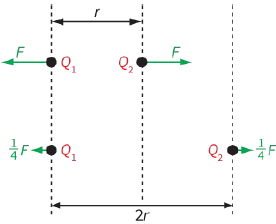
Following your earlier study of Newton’s law of gravitation, you should not be surprised by this relationship. The force depends on each of the properties producing it (in this case, the charges), and it is an inverse square law with distance–if the particles are twice as far apart, the electrical force is a quarter of its previous value (Figure 22.3).
.Coulomb’s law
Note also that, if we have a positive and a negative charge, then the force F is negative. We interpret this as an attraction. Positive forces, as between two like charges, are repulsive. In gravity, we only have attraction.
So far, we have considered point charges. If we are considering uniformly charged spheres we measure the distance from the centre of one to the centre of the other – they behave as if their charge was all concentrated at the centre. Hence, we can apply the equation for Coulomb’s law for both point charges (e.g. protons, electrons, etc.) and uniformly charged spheres, as long as we use the centre-to-centre distance between the objects.
PRACTICAL ACTIVITY 22.1
Investigating Coulomb’s law
It is quite tricky to investigate the force between charged objects, because charge tends to leak away into the air or to the Earth during the course of any experiment. The amount of charge we can investigate is difficult to measure, and usually small, giving rise to tiny forces.
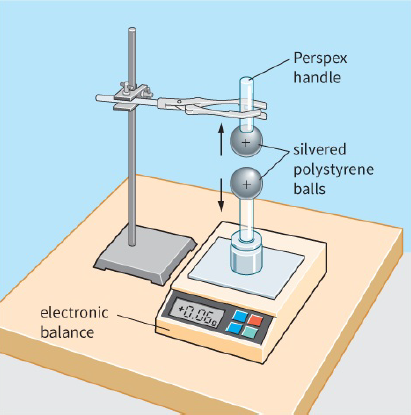
Figure 22.4 shows one method for investigating the inverse square law for two charged metal balls (polystyrene balls coated with conducting silver paint). As one charged ball is lowered down towards the other, their separation decreases and so the force increases, giving an increased reading on the balance.