Physics A Level | Chapter 22: Coulomb’s law 22.4 Electric potential
When we discussed gravitational potential (Chapter 17), we started from the idea of potential energy. The potential at a point is then the potential energy of unit mass at the point. We will approach the idea of electrical potential in the same way. However, you may be relieved to find that you already know something about the idea of electrical potential, because you know about voltage and potential difference.
This topic shows how we formalise the idea of voltage, and why we use the expression ‘potential difference’ for some kinds of voltage.
Electric potential energy
When an electric charge moves through an electric field, its potential energy changes. Consider this example: if you want to move one positive charge closer to another positive charge, you have to push it (Figure 22.6). This is simply because there is a force of repulsion between the charges. You have to do work in order to move one charge closer to the other.
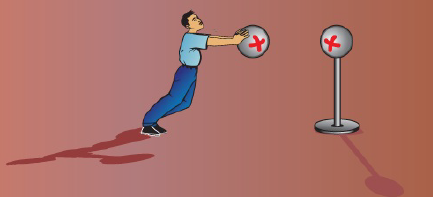
In the process of doing work, energy is transferred from you to the charge that you are pushing. Its potential energy increases. If you let go of the charge, it will move away from the repelling charge. This is analogous to lifting up a mass; it gains gravitational potential energy as you lift it, and it falls if you let go.
Energy changes in a uniform field
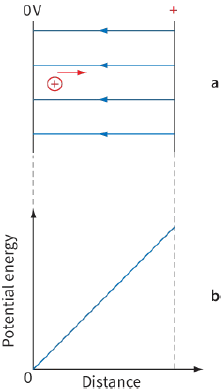
We can also think about moving a positive charge in a uniform electric field between two charged parallel plates. If we move the charge towards the positive plate, we have to do work. The potential energy of the charge is therefore increasing. If we move it towards the negative plate, its potential energy is decreasing (Figure 22.7a).
Since the force is the same at all points in a uniform electric field, it follows that the energy of the charge increases steadily as we push it from the negative plate to the positive plate. The graph of potential energy against distance is a straight line, as shown in Figure 22.7b.
We can calculate the change in potential energy of a charge Q as it is moved from the negative plate to the positive plate very simply. Potential difference is defined as the energy change (joules) per unit charge (coulombs) between two points (recall from Chapter 8 that one volt is one joule per coulomb). Hence, for charge Q, the work done in moving it from the negative plate to the positive plate is:
$W = QV$
We can rearrange this equation as:
$V = \frac{W}{Q}$
This is really how voltage V is defined. It is the energy per unit positive charge at a point in an electric field. By analogy with gravitational potential, we call this the electric potential at a point. Now you should be able to see that what we regard as the familiar idea of voltage should more correctly be referred to as electric potential. The difference in potential between two points is the potential difference (p.d.) between them.
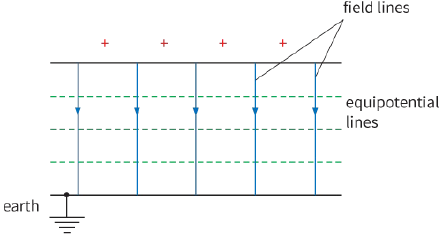
Just as with gravitational fields, we must define the zero of potential (this is the point where we consider a charge to have zero potential energy). Usually, in a laboratory situation, we define the Earth as being at a potential of zero volts. If we draw two parallel charged plates arranged horizontally, with the lower one earthed (Figure 22.8), you can see immediately how similar this is to our idea of gravitational fields. The diagram also shows how we can include equipotential lines in a representation of an electric field.
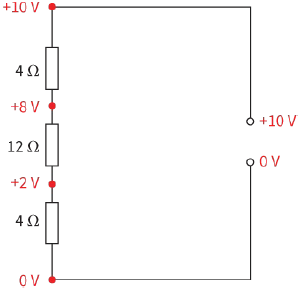
We can extend the idea of electric potential to measurements in electric fields. In Figure 22.9, the power supply provides a potential difference of $10 V$. The value of the potential at various points is shown. You can see that the middle resistor has a potential difference across it of $(8 - 2)\,V = 6V$.
Energy in a radial field
Imagine again pushing a small positive test charge towards a large positive charge. At first, the repulsive force is weak, and you have only to do a small amount of work. As you get closer, however, the force increases (Coulomb’s law), and you have to work harder and harder.
The potential energy of the test charge increases as you push it. It increases more and more rapidly the closer you get to the repelling charge. This is shown by the graph in Figure 22.10. We can write an equation for the potential V at a distance r from a charge Q:
$V = \frac{Q}{{4\pi {\varepsilon _0}r}}$
where V is the potential near a point charge Q, ${{\varepsilon _0}}$ is the permittivity of free space and r is the distance from the point.
(This comes from the calculus process of integration, applied to the Coulomb’s law equation.)
You should be able to see how this relationship is similar to the equivalent formula for gravitational potential in a radial field:
$\phi = - \frac{{GM}}{r}$
Note that we do not need the minus sign in the electric equation as it is included in the charge. A negative charge gives an attractive (negative) field whereas a positive charge gives a repulsive (positive) field.
We can show these same ideas by drawing field lines and equipotential lines. The equipotentials get closer together as we get closer to the charge (Figure 22.11).
To arrive at this result, we must again define our zero of potential. Again, we say that a charge has zero potential energy when it is at infinity (some place where it is beyond the influence of any other charges).
If we move towards a positive charge, the potential is positive. If we move towards a negative charge, the potential is negative.
This allows us to give a definition of electric potential: The electric potential at a point is equal to the work done per unit charge in bringing unit positive charge from infinity to that point.
Electric potential is a scalar quantity. To calculate the potential at a point caused by more than one charge, find each potential separately and add them. Remember that positive charges cause positive potentials and negative charges cause negative potentials.
Electrical potential energy
We have already defined electric potential energy between two points A and B as the work done in moving positive charge from point A to point B. This means that the potential energy change in moving point charge ${Q_1}$ from infinity towards a point charge Q2 is equal to the potential at that point due to ${Q_2}$ multiplied by Q1. In symbol form:
$W = V{Q_2}$
The potential V near the charge ${Q_2}$ is:
$V = \frac{{{Q_2}}}{{4\pi {\varepsilon _0}r}}$
Thus the potential energy of the pair of point charges W (shown as ${E_p}$ in the equation) is:
${E_p} = \frac{{{Q_q}}}{{4\pi {\varepsilon _0}r}}$
Electric potential difference near a charged sphere
We have already seen that the electric potential $\Delta V$ at a distance r from a point charge Q is given by the equation:
$\Delta V = \frac{Q}{{4\pi {\varepsilon _0}r}}$
The potential difference between two points, one at a distance r1 and the second at a distance r2 from a charge Q is:
$\begin{array}{l}
\Delta V = \frac{Q}{{4\pi {\varepsilon _0}{r_1}}} - \frac{Q}{{4\pi {\varepsilon _0}{r_2}}}\\
= \frac{Q}{{4\pi {\varepsilon _0}}}\left[ {\frac{1}{{{r_1}}} - \frac{1}{{{r_2}}}} \right]
\end{array}$
This reflects the similar formula for the gravitational potential energy between two points near a point mass.
Field strength and potential gradient
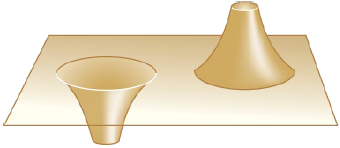
We can picture electric potential in the same way that we thought about gravitational potential. A negative charge attracts a positive test charge, so we can regard it as a potential ‘well’. A positive charge is the opposite–a ‘hill’ (Figure 22.12). The strength of the field is shown by the slope of the hill or well:
$field strength = −potential gradient$
The minus sign is needed because, if we are going up a potential hill, the force on us is pushing us back down the slope, in the opposite direction.
This relationship applies to all electric fields. For the special case of a uniform field, the potential gradient E is constant. Its value is given by:
$E = - \frac{{\Delta V}}{{\Delta d}}$
where V is the potential difference between two points separated by a distance d.
(This is the same as the relationship $E = \frac{V}{d}$ quoted in Chapter 21.)
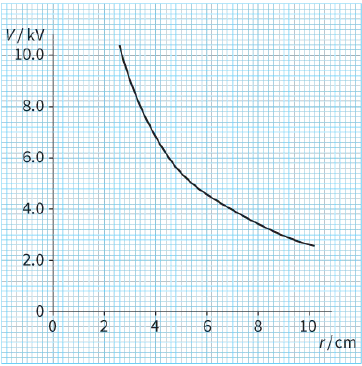
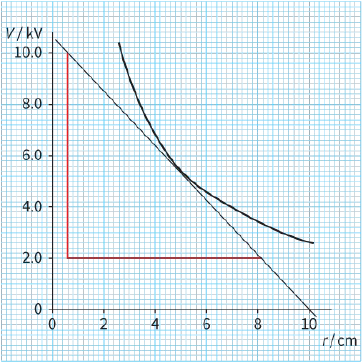
Worked example 3 shows how to determine the field strength from a potential–distance graph.
Questions
3) a: What is the electrical potential energy of a charge of $+1 C$ placed at each of the points A, B, C, D between the charged, parallel plates shown in Figure 22.15?
b: What would be the potential energy of $a +2 C$ charge at each of these points? (C is halfway
between A and B, D is halfway between C and B.)
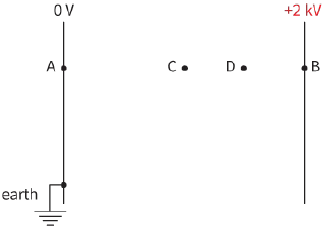
4) A Van de Graaff generator has a spherical dome of radius $10 cm$. It is charged up to a potential of $100000 V$ ($100 kV$). How much charge is stored on the dome? What is the potential at a distance of $10 cm$ from the dome?
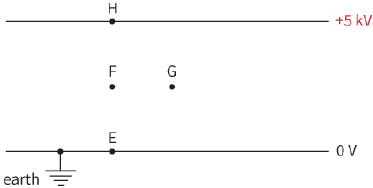
How much work is done in moving $a +1 C$ charge along the following paths shown in Figure
5) a: 22.16: from E to H; from E to F; from F to G; from H to E?
b: How do your answers differ for a:
i- $-1 C$ charge?
ii- $+2 C$ charge?