
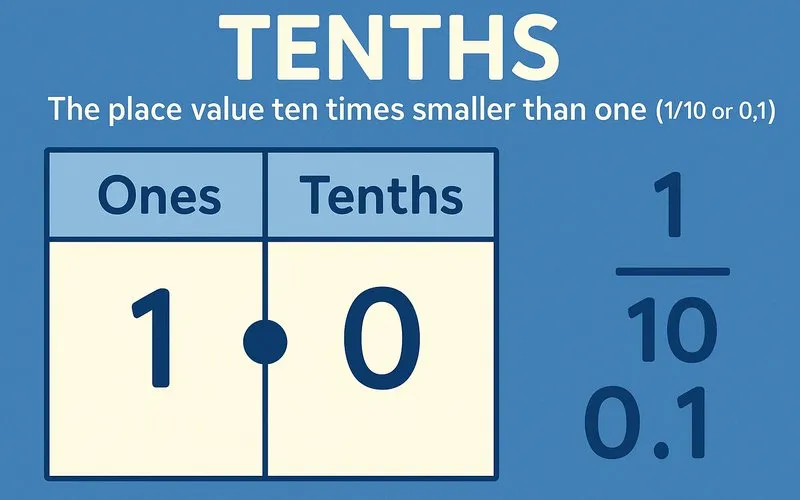
Tenths: The First Step into the Decimal World
What Exactly is a Tenth?
Imagine you have a whole pizza. If you cut it into ten equal slices, each one of those slices represents one-tenth of the pizza. In mathematics, we write this as $1/10$ or as a decimal, 0.1. The zero shows there are no whole units, the decimal point separates the whole numbers from the parts, and the one in the first place to the right shows we have one part out of ten.
The place value system is built on powers of ten. Each move to the left multiplies the value by 10, and each move to the right divides it by 10. Therefore, the place immediately to the right of the ones place is the tenths place, which is $1/10$ the value of one.
Representing Tenths in Different Forms
Tenths can be expressed in several ways, making them a versatile concept. The three most common representations are fractions, decimals, and visual models like grids and number lines.
Fraction Form: This is the most direct representation. A tenth is written as $1/10$. If you have three-tenths, you write $3/10$. The denominator (10) tells you the whole is divided into ten equal parts, and the numerator (3) tells you how many of those parts you have.
Decimal Form: This is the standard notation used in most calculations. The decimal point is key. The number 0.8 means 8 tenths. There are 0 wholes and 8 tenths. We can write this as $0.8 = 8/10$.
Visual Models: Drawing a rectangle divided into 10 equal parts and shading 4 of them is a powerful way to visualize 0.4 or $4/10$. Similarly, on a number line between 0 and 1, the point exactly in the middle is 0.5, representing five-tenths.
| Fraction | Decimal | Word Form | Description |
|---|---|---|---|
| $1/10$ | 0.1 | One tenth | One part out of ten equal parts. |
| $5/10$ | 0.5 | Five tenths | Half of a whole; five out of ten parts. |
| $9/10$ | 0.9 | Nine tenths | Almost a whole unit; nine out of ten parts. |
| $10/10$ | 1.0 | Ten tenths | Equal to one whole unit. |
Operations with Tenths: Adding and Subtracting
Working with tenths in addition and subtraction is straightforward if you remember to align the decimal points. The decimal point acts as an anchor, ensuring that you are adding tenths to tenths and ones to ones.
Example 1: Adding Tenths
Let's add 0.4 and 0.5.
Step 1: Write the numbers vertically, aligning the decimal points.
0.4
+ 0.5
-----
Step 2: Add the digits in the tenths place: $4 + 5 = 9$.
Step 3: Bring down the decimal point.
The answer is 0.9.
Example 2: Subtracting Tenths
Let's subtract 0.8 from 1.2.
Step 1: Write the numbers vertically, aligning the decimal points.
1.2
- 0.8
-----
Step 2: Since 8 is larger than 2 in the tenths place, we need to regroup. Borrow 1 from the ones place. The 1 becomes 0, and the 2 tenths become 12 tenths.
Step 3: Subtract the tenths: $12 - 8 = 4$ tenths.
Step 4: Subtract the ones place: $0 - 0 = 0$.
The answer is 0.4.
Tenths in the Real World: Practical Applications
Tenths are not just an abstract mathematical idea; they are used constantly in daily life. Recognizing them helps us make sense of the world around us.
Money: While the US dollar is divided into 100 cents (hundredths), tenths appear in many financial contexts. If an item costs $2.50, you can think of this as 2 whole dollars and 5 tenths of a dollar, or 50 cents. Stock market prices often change by tenths of a point.
Measurement: This is where tenths are most visible. A ruler or a tape measure is often marked in tenths of an inch or centimeter. If you measure a piece of wood and it is 5.3 inches long, that means it is 5 whole inches and 3 tenths of an inch long. In the metric system, which is based on powers of ten, tenths are fundamental. There are 10 decimeters in a meter, and a decimeter is one-tenth of a meter.
Sports and Statistics: Athletic performances are frequently measured in tenths. A sprinter's time might be 10.8 seconds. A baseball player's batting average is calculated to three decimal places, but the first decimal is a tenth, indicating a general performance level (e.g., a .300 hitter is very good).
Weather and Science: Thermometers often show temperature in tenths of a degree. A rainfall measurement might be 1.4 inches. In scientific experiments, measurements are routinely recorded to the nearest tenth to ensure precision.
The Relationship Between Tenths and Other Decimal Places
Understanding tenths opens the door to the entire decimal system. The pattern of dividing by ten continues indefinitely to the right of the decimal point.
- Hundredths: The place value to the right of tenths is hundredths. One hundredth is one-tenth of a tenth. $1/100 = 0.01$. There are 10 hundredths in one tenth. So, 0.10 (ten hundredths) is equal to 0.1 (one tenth).
- Thousandths: The next place is thousandths. One thousandth is one-tenth of a hundredth. $1/1000 = 0.001$. There are 10 thousandths in one hundredth, and 100 thousandths in one tenth.
This hierarchical structure shows how the decimal system is beautifully consistent. Moving one place to the right always means dividing by 10, and moving one place to the left always means multiplying by 10.
Common Mistakes and Important Questions
Q: Is 0.10 the same as 0.1?
Yes, absolutely. 0.10 means 1 tenth and 0 hundredths, which is the same as 1 tenth (0.1). Adding a zero to the right of a decimal number does not change its value, just like how 5 is the same as 05. However, the zero can sometimes indicate a level of precision in measurement.
Q: Why is the first decimal place called "tenths" and not "tens"?
The place value names are based on the value of the unit, not the digit. The place to the left of the decimal point is the "ones" place. The value of the place to its right is one-tenth the value of the "ones" place, so it's logically called the "tenths" place. The "tens" place is to the left of the "ones" place and is ten times larger, not smaller.
Q: What is the most common error when adding numbers with tenths?
The most frequent error is misaligning the decimal points. If you try to add 4.2 and 0.35 by aligning the digits on the right instead of the decimal point, you would be adding the 2 (tenths) to the 5 (hundredths), which is incorrect. Always line up the decimal points to ensure you are adding values in the same place.
Footnote
1 Decimal Point: A dot (.) used to separate the whole number part from the fractional part in a decimal number. It indicates where the place values shift from powers of ten (ones, tens, hundreds) to inverse powers of ten (tenths, hundredths, thousandths).
2 Place Value: The numerical value that a digit has by virtue of its position in a number. For example, in the number 5.2, the digit 5 is in the ones place and has a value of 5, while the digit 2 is in the tenths place and has a value of $2 \times (1/10)$ or 0.2.